

Balance quantity and quality to boost sales performance
The balance of quantity and quality of activity is a necessary part of sales success. Getting the balance right and maintaining consistency is the tricky part, as is defining and teaching what constitutes quality.
Applying an appropriate weighting to quantity and quality depends on the context. Across the same sales function there will be different weightings for individuals working with different lead types.
It is all too common however, to over prescribe quantity – call volumes, meeting volumes, pitches delivered, quotations sent for example, without sufficient attention to quality.
Quantity as a strategy
There are cases where weighting towards quantity is a legitimate and highly effective sales approach. For example, new regulation may have created an opportunity for your company but also for your competitors. You want to achieve first-mover advantage or secure a good market-share.
A quantity approach to selling activity is therefore needed. Sales systems and processes may feel the strain and quality may suffer slightly. The finite window of opportunity, however, makes that not only palatable but necessary.
Quality as a strategy
A weighting towards quality might be best if you want to make inroads into a new market and displace incumbents. Differentiation and perceived greater value in the eyes of the customer is more likely to dislodge competitors.
The impact of balance
Calibrating the balance between quantity and quality always needs that careful consideration of the context.
It may take several attempts and some finetuning to achieve the perfect quantity and quality balance to meet each situation. When you achieve that balance the effect is powerful, converting opportunities into customers will be optimised.
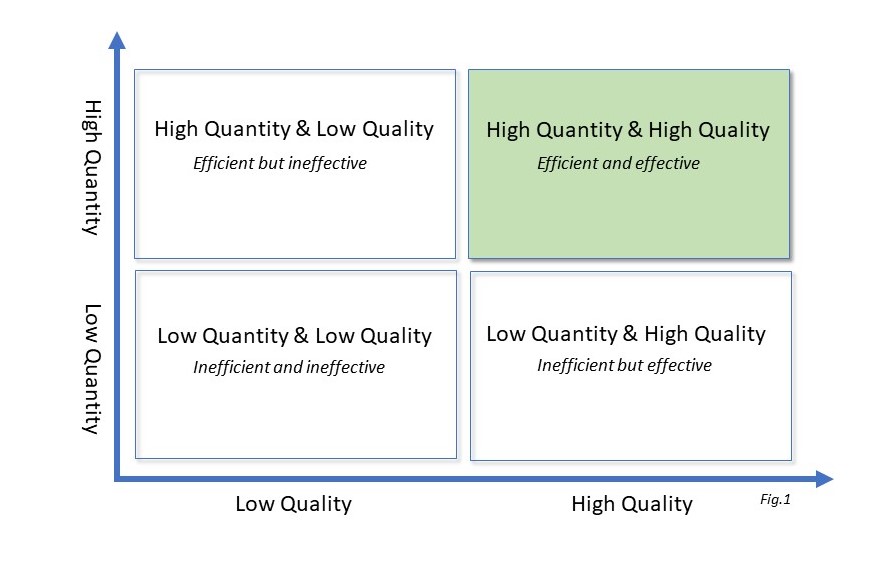
Fig.1 above describes the impact of the balance of quantity and quality on sales success, also referred to as efficiency and effectiveness.
Where might you place each member of your sales team today on this grid? Clearly you would not want anyone in the bottom left corner nor top left. The aim is to migrate your entire team to occupy the top right position. This part of the grid is where quantity and quality are in balance. They are optimised to achieve specific sales objectives in the most efficient and effective way.
If you can place all members of your team in this section of the grid:
- The performance gap between least effective and most effective is narrow
- Conversion rates are higher
- Sales success and its continuity is de-risked
- Dependency on one or two salespeople is eliminated
- Team morale is high
- Healthy in-team competition exists
The importance of best practice in achieving balance
Documenting and training best practice is important. It is the ‘roadmap’ to moving salespeople from elsewhere on the grid to the top right.
Documenting best practice takes time and attention to detail. It is an aggregation of everything that leads to success so that it can be repeated.
Best practice requires inputs from sales leaders, salespeople, wider business colleagues, customers won, and prospective customers lost.
Best practice acts as:
- A sales operating manual
- A training manual
- A diagnostic for the business to address sales performance issues
- A self-diagnostic for individual salespeople who experience a dip in performance
Quantity of activity and the quality of it have a profound and positive impact on performance. Conversely, when either is out of balance the consequences can be extremely damaging.
Do you have the balance right today?
If you want a sales team which drives revenues, delivers high return on its costs, and is consistent, this deceptively simple model works – focus on the right quantity of activity and its quality in line with best practice
Fivefold Associates helps its clients to build a best practice standard.
